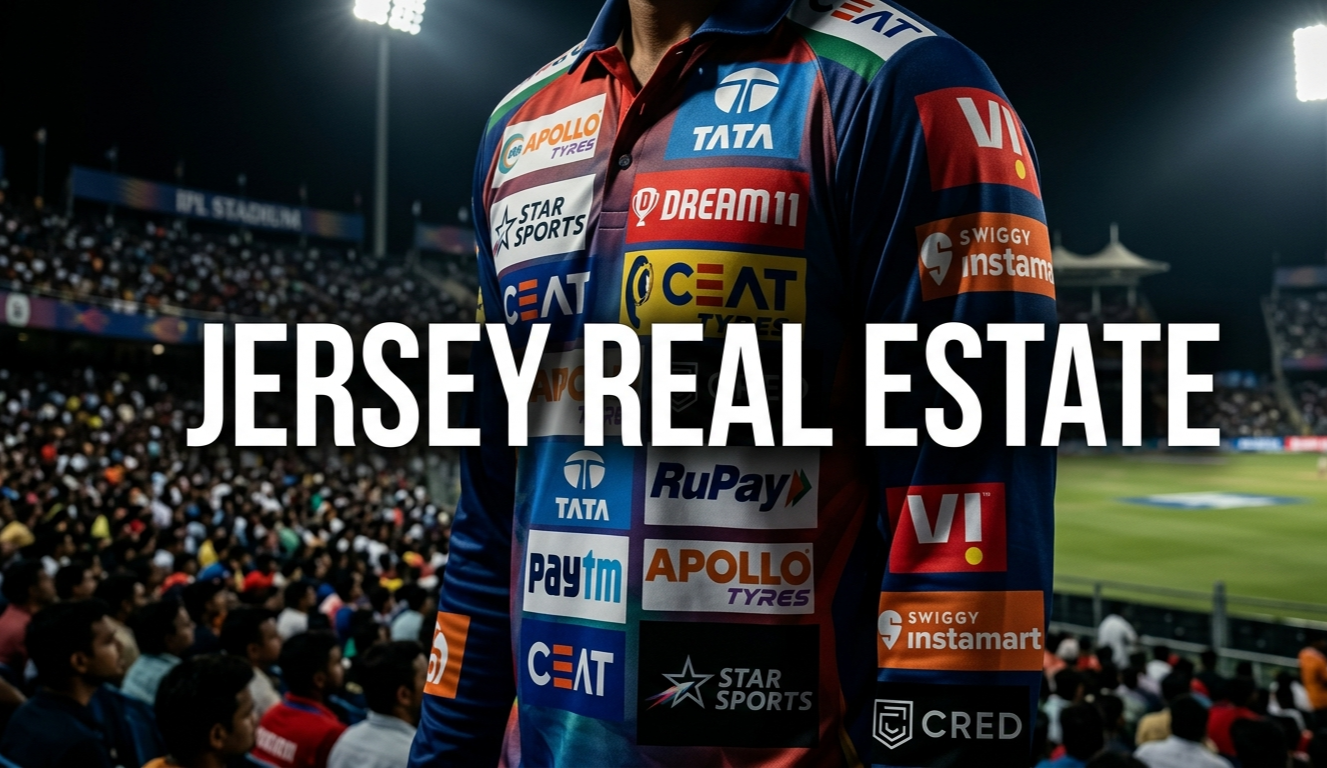
IPL Jersey Sponsorship — How Teams Price Every Inch of Their Kit (2026)
From ₹40 crore front chest deals to ₹3 crore trouser logos — here’s exactly how IPL teams price every inch of their jersey and why brands pay crores for it.
Are you someone who secretly prefers a jersey your team used to wear but doesn’t anymore? That’s peak fan behaviour — but have you ever been curious enough to think about how and why Aircel convinced CSK to put their logo on the chest? It could have been on the shoulder or the back.
That question matters more than you think — and if it just crossed your mind, you’re in the right place.
In today’s blog we explain, how the jersey-real-estate assets are valued, how intermediaries play a huge role in making deals beneficial for both sponsors and teams, and which brands are sponsoring which teams in 2026, how it benefits the sponsors. If you haven’t read our breakdown of how IPL sponsorship works — [start here first.]
Consider this the next chapter.
IPL Team Sponsorship- How the Jersey-Real-Estate Assets are Valued?
Top teams like MI, RCB and CSK command ₹40–60 crore for a front of jersey deal. Smaller teams get ₹15–25 crore for the exact same spot.
But here’s what makes it fascinating — every team plays the same number of league matches. Same broadcast time. Same cameras. Same 600 million viewers. And yet brands willingly pay an extra ₹20 crore to put their logo on a Mumbai Indians jersey over a Punjab Kings one.
So what exactly justifies that gap? Several factors work together to determine what a jersey spot is actually worth — and they have nothing to do with how many matches a team plays.

sq ft. An IPL front jersey spot costs ₹32 crore
per sq inch. Same city. Very different real estate.
Factors affecting IPL team sponsorship valuation:
1. Performance Premium:
Sponsorship is not just about exposure — it’s about association. Brands don’t just want their logo seen by 600 million viewers. They want it seen on a winning team.
Think of it like property prices. A flat in a locality that suddenly gets a new metro station doesn’t just become more visible — it becomes more valuable overnight. IPL teams work the same way.
RCB’s maiden IPL title last season is the perfect example. The moment they lifted that trophy, their jersey became the most desirable real estate in the league. Their sponsorship value surged — brands that had hesitated for years suddenly wanted in. Winning doesn’t just change the scoreboard. It changes the price tag on every inch of that jersey
2. Location:
In real estate, location is everything. A flat in South Mumbai commands a price that a similar flat in a smaller city simply cannot — not because it’s bigger or better built, but because of what surrounds it.
IPL jersey sponsorship works exactly the same way.
Mumbai Indians are based in India’s financial capital — home to the highest density of corporate headquarters, the deepest consumer spending power, and the largest concentration of the brands that actually buy sponsorships. A brand associating with MI isn’t just buying jersey space — they’re buying association with Mumbai itself.
Punjab Kings, despite having a passionate fanbase, operate in a market that simply doesn’t carry the same commercial weight. Brands know this — which is why their research goes far beyond match viewership numbers into understanding exactly which market a franchise calls home.
3. Star Player Association:
In real estate, a heritage building commands a price no new construction can match — not because of its size, but because of its history and the stories attached to it.
RCB, MI and CSK carry that same heritage premium.
Virat Kohli and MS Dhoni haven’t just played cricket — they’ve built religions. CSK’s fanbase isn’t confined to Chennai. It spans every state, every city, every cricket mad household in India. The same goes for RCB’s Kohli faithful. These aren’t regional fanbases — they’re national movements built around individual legends.
For a brand, associating with CSK doesn’t just mean reaching Chennai. It means reaching every MSD fan from Kashmir to Kanyakumari. That’s a pan-India audience that no location based metric can capture — and brands pay accordingly.
Teams that have all three — performance, location and star power — command the highest sponsorship values because brands actively compete against each other for every available spot on their jersey. The more brands want in, the higher the price goes. Think of it as the most contested real estate in Indian sport.
We’ve put together a breakdown across three tiers to give you a clearer picture.
Pricing By Position — Industry Expert Estimates
These are the most accurate publicly available figures from sports marketing experts:
Tier 1 — Premium Teams (MI, CSK, RCB, KKR)
MI, CSK and RCB each reportedly generate close to ₹150 crore annually through team sponsorships — sitting in a commercial league of their own
| Position | Estimated Rate Per Season |
| Front of shirt | ₹40–60 crore |
| Back of shirt | ₹15–20 crore |
| Right upper chest | ₹12–18 crore |
| Leading arm | ₹8–12 crore |
| Helmet/cap | ₹6–10 crore |
| Sleeves (x2) | ₹4–8 crore each |
| Trousers (x2) | ₹3–5 crore each |
| Back of helmet | ₹2–4 crore |
Tier 2 — Mid Teams (SRH, DC, RR, GT)
| Position | Estimated Rate Per Season |
| Front of shirt | ₹20–35 crore |
| Back of shirt | ₹8–12 crore |
| Right upper chest | ₹6–10 crore |
| Leading arm | ₹4–7 crore |
| Helmet/cap | ₹3–6 crore |
| Sleeves (x2) | ₹2–4 crore each |
| Trousers (x2) | ₹1–3 crore each |
| Back of helmet | ₹1–2 crore |
Tier 3 — Smaller Teams (PBKS, LSG)
| Position | Estimated Rate Per Season |
| Front of shirt | ₹15–25 crore |
| Back of shirt | ₹5–8 crore |
| Right upper chest | ₹3–6 crore |
| Leading arm | ₹2–5 crore |
| Helmet/cap | ₹2–4 crore |
| Sleeves (x2) | ₹1–3 crore each |
| Trousers (x2) | ₹1–2 crore each |
| Back of helmet | ₹50L–1 crore |
All figures are industry estimates based on publicly available data. Exact deal values remain commercially confidential between franchises and sponsors
Source: Industry estimates via SocialSamosa and InsideSport. Exact figures are commercially confidential
Role of Intermediaries-The middle men

→ Jersey Deal. This four step process is how every
logo you see on match day gets there — and most
fans never knew it existed.
Do you get excited for your favourite team’s jersey reveal? What you see on launch day is actually the result of a process that began almost a year earlier — right after the previous season ended — when franchises map out their available assets and begin approaching the market.
There’s a famous saying that India has two Diwalis — one in November and one when the IPL begins. And that’s not just a cultural observation. It’s a commercial calendar. Brands that have just spent heavily on Diwali marketing campaigns turn their attention almost immediately to IPL sponsorship planning — and the first call they make is to a sports marketing agency.
These agencies are the real architects of jersey deals. They don’t just suggest opportunities — they package assets, match brands with the right franchises, negotiate commercials, and structure deals that work for both sides. Without them, a brand like Mahindra would have no way of knowing that sponsoring four teams across three different deal types could be more effective than one expensive title sponsorship
Mahindra — an ITW Catalyst client — made headlines with one of the smartest sponsorship strategies in recent IPL history. Their brief was simple but ambitious: with a limited budget, how do you challenge your direct competitor Tata, who just signed a ₹2,500 crore title sponsorship deal?
ITW Catalyst’s answer was to go wide instead of deep. Rather than spending everything on one team, Mahindra signed deals across four franchises — a non-jersey official partnership with MI and RR, back of cap with DC, and trouser branding with RCB. Four teams. Three deal types. One cohesive strategy that created more combined visibility than a single expensive deal ever could.
“When you partner with four teams, your share of voice increases,” said one sports marketing executive involved in the deal.
On average, each IPL franchise works with 4–5 such agencies simultaneously — each bringing different brand relationships and market expertise to the table. Which raises the obvious question: who exactly are these agencies, what do they do, and why does this industry even exist?
When brands approach agencies in November, the first step is a needs assessment — understanding the brand’s marketing objectives, target audience, and budget. The agency then maps those needs against available jersey inventory across franchises and presents the best fit options.
On the franchise side, marketing teams are already stretched — managing match day content, player social media, fan engagement campaigns, and a hundred other moving parts simultaneously. Sponsorship deal management — with its legal paperwork, commercial negotiations, and activation planning — is simply too large a workload to handle independently. Agencies absorb that entire process.
In return they typically earn a commission of 10–15% on the deal value — meaning on a ₹40 crore front chest deal, the agency walks away with ₹4–6 crore for their role in making it happen.
Not all agencies operate from the same position. JSW Sports and RISE Worldwide hold a unique advantage — their parent companies are IPL franchise owners themselves. JSW Group owns Delhi Capitals and Reliance Industries owns Mumbai Indians.
This creates a natural conflict of interest question — would a competitor’s agency truly prioritise your team’s commercial interests? It’s a doubt that quietly circulates among franchises.
JSW Sports’ deputy manager addressed it directly: “There’s a communication barrier in terms of how we approach a client and how we close deals. The revenues and marketing spends for each team vary depending on the market, budget, and other factors.”
RISE Worldwide declined to comment.
It’s a tension that reveals something important about the intermediary ecosystem — trust is as valuable as expertise. And in a league where brands are spending crores on a jersey spot, who manages your deal matters as much as what the deal says.
One aspect of sponsorship that is often overlooked is activation — and it might be the most important part of the entire deal.
Mithil Jaysen, deputy manager at JSW Sports, put it plainly: for every rupee spent on securing a sponsorship, brands should spend 2.5 rupees on activating it. Activation typically begins in March when players report to their franchises — creating the first window for brands to shoot content, launch campaigns, and begin building their association with the team in the public eye.
A logo on a jersey is just the beginning. The full commercial benefit is unlocked when brands go beyond broadcast visibility and invest in digital content, fan engagement campaigns, influencer activations, and match day experiences. Dream11 didn’t build 210 million users by putting their logo on five jerseys — they built it by creating fantasy campaigns, interactive content, and digital activations that turned passive viewers into active participants.
Sponsorship without activation is like buying a prime property and leaving it empty. The asset is there — but the value isn’t being generated.
Which brings us to the final question — what does modern sponsorship actually offer brands beyond a jersey logo?
What does modern sponsorship actually offer brands beyond a jersey logo?
Have you ever seen an ad featuring Virat or Rohit still appearing on screen months after the IPL season ended? That’s because there is a contractual clause that allows brands to use player creatives until 31st December — with three players allotted per brand for shoots.
A jersey sponsorship is something far beyond just logo placement — and that makes it worth every crore spent.
Here’s what brands actually get when they sign a jersey deal:
- On-ground logo exposure on perimeter boards and giant screens — visibility that goes beyond the jersey itself
- Match tickets (30–60 per game depending on venue) — which brands use to reward dealers, distributors, or consumers through contests
- Behind-the-scenes team content — exclusive footage that brands can shape and use for their own campaigns
- Player time — for commercial shoots, meet-and-greets, and brand events
- Rights to use player imagery and the team logo across all brand communication
- Signed merchandise and digital assets — which brands can use to create their own fan merchandise
- Stadium selling rights — allowing food and beverage brands to sell directly to 50,000 captive fans on match day
- Category exclusivity — meaning no rival brand can sign with the same team. If you’re in, your competitor is out.
Brands try to squeeze out every ounce of value from their sponsorships — match day campaigns, during-match offers, post-season creatives running until December. So who exactly are these brands and which teams have they chosen to back in 2026? Curious? Let’s find out Let’s find out.
Who Is Sponsoring Who — IPL 2026 Team Sponsorship Breakdown
In 2025 — for the first time in IPL history — all 100 jersey sponsorship spots across all 10 franchises were filled. Not one logo space went unsold.
The same season saw total team sponsorship revenue cross ₹1,000 crore for the first time, while viewership crossed 500 million — making IPL the single biggest platform around which brand content strategies in India are built.
So who exactly are the brands that claimed their piece of this real estate in 2026? Here’s the full breakdown
| Team | Title/ Principle Sponsor | Associate Sponsor | Official partners | Merchandise/Kit Partners |
| MI | Lauritz Knudsen, DHL | Malaysia Air, Skechers, Jio, Astral Pipes | Plum, Campa, Udemy, BKT, Reliance Digital, Avon Cycles, Pokemon | Chupps, Cricket Icons, Rapoo, Real Cricket |
| CSK | Etihad Airways, FedEx, Ashok Leyland | British Empire, Astral Pipes, Tecno, Coca-Cola, Vodafone Idea | Surf Excel, Amul Protein, Hello FM, Fever FM | PlayR |
| RCB | Nothing Technology, Sun Pharma, BKT, Jio | Puma, Atlassian, boAt, Nippon Paint, Emmvee | BigBasket, Bisleri, Kingfisher, Cricbuzz, Manipal Hospitals, ChatGPT | Red FM, Radio City, Radio One |
| KKR | VIDA, BKT, RR Kabel | Jio, Joy, Google Pay, Vikram Solar, Amaron | Kingfisher, Google AI, Thums Up, Amul, BGMI, BigAnt | Six5Six, Cricket Icons, Milton, Fever FM |
| SRH | Dream11, BKT, Kent Water, Jio | Lubi Pumps, Avon Cycles, JSW Paints | Campa, AirAsia, Kingfisher, Apollo Hospitals, Star Health | FanCode Shop, PlayR, Filmy Dice |
| DC | Hero Fincorp, DP World | GMR Group, Puma, Jio, Amaron, KP Group | HSBC, ChatGPT, Bisleri, Kingfisher, Amul Protein, Bharat Taxi | Milton, BigAnt Studios, Krafton |
| RR | Waaree, JX Laxmi, Red Bull | Jio, Oaksmith, Ecolink, Goel TMT | Dream11, BKT, Amul Protein, Bisleri, Poornima | Real Cricket, BigAnt, Cricket Icons, Vany |
| PBKS | CP Plus, BKT, Kent, Jio | Freemans, Hell Energy Drinks | Highland, Big FM, Livguard, District by Zomato | Nivia, Cricket Icons, SUVI |
| GT | Birla Estates | Jio, Torrent Group, BKT, Google Pixel, Livpure | Campa, Scapia, AirAsia, Pokemon, BookMyShow | T10 Sports, Baller Athletik, Chupps |
| LSG | JK Super, BKT, KEI | Jio, SBI Life, Too Yumm, Freemans | Kingfisher, Sprite, Amul, Mirchi, Big FM | Real Cricket, Radio City |
As BCCI’s restrictions on fantasy gaming apps took effect, they created a commercial void worth ₹350 crore in IPL’s jersey ecosystem. That void has since been filled by aviation giants like Etihad Airways, clean energy brands like Waaree Solar — and for the first time in IPL history, AI brands like Google Gemini and Nothing Technology are now part of the league’s commercial fabric.
The jersey has always been a mirror of India’s economy. And right now, that mirror is showing us exactly where the country is headed.
We are done for today — hope you enjoyed the blog! Do like, share, and if you want to read more content like this, subscribe so you never miss an update. Drop your views in the comment box below — we read every one.
And if you think jersey deals are fascinating — wait till you read how one brand paid ₹350 crore just to walk away from IPL. That story is coming next.