Why Vivo Paid ₹454 Crore to Exit IPL — The Full Story
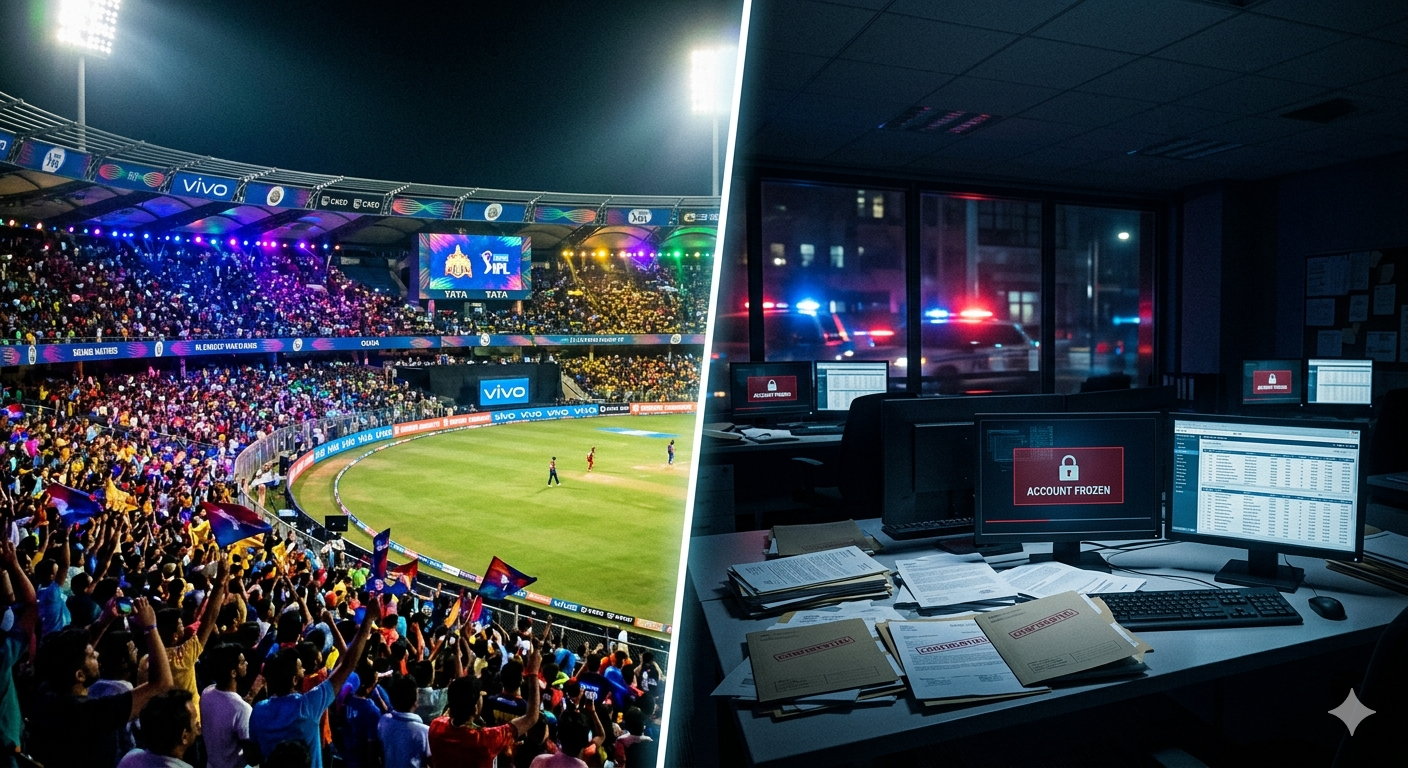
Vivo paid ₹454 crore just to walk away from IPL. Here’s the full story — Galwan Valley, anti-China sentiment, ED raids, CEO arrest and how Tata stepped in.
Ever wondered what led to the early Vivo IPL exit? Suppose a friend sticks with you at your lowest point in life — gives you everything you need, no questions asked. Both of you climb together, achieve things neither could alone. And then suddenly, you have to part ways. Not because of anything between you two. But because your parents ended up on opposite sides of a fight.
Sounds pointless, right? But that is exactly what happened between Vivo and IPL in 2020.
If that got you curious, this blog is for you. Here’s everything we’re unfolding today:
- How BCCI signed Vivo amid the fixing scandal in 2016
- Vivo’s massive ₹2,199 crore renewal for 2018–22
- The Galwan Valley clash that changed everything in 2020
- Why Vivo quietly came back in 2021
- How Tata stepped in as title sponsor in 2022
- July 2022 — The hidden story nobody talked about
The Vivo story only makes sense if you understand how IPL’s entire sponsorship ecosystem works — who pays, who benefits, and why brands spend crores just to be associated with a cricket tournament. 👉 Read: Who’s Really Paying for IPL? A Fan’s Guide to How Sponsorship Works
How BCCI signed Vivo after Pepsi walked out over the spot-fixing scandal in 2016
July 14, 2015. The Justice RM Lodha Committee delivered its verdict on IPL’s spot-fixing and betting scandal — and it was devastating. CSK and RR were suspended for two years. Gurunath Meiyappan and Raj Kundra, team principals of the two franchises, were banned from cricket entirely.
The damage didn’t stop in the courtroom. Across India, one question was spreading fast — is the entire league fixed? The IPL’s reputation, built over seven seasons, was bleeding out in public.
And then came the final blow. On October 18, 2015, PepsiCo walked out — terminating its title sponsorship deal with BCCI three years before it was due to end.
But amid all this chaos, Vivo arrived as a messiah — signing on as the title sponsor for the 2016–17 seasons at ₹100 crore per year, a total commitment of ₹200 crore for two years.
This initial contract was not competitively bid at full market value — Vivo entered as an emergency replacement after Pepsi’s early exit. But the brand extracted every rupee of visibility from the association.
In 2016, Vivo signed Ranveer Singh as its brand ambassador — amplifying its IPL-driven mass awareness and aligning perfectly with the identity it was building: a camera and music-first smartphone brand targeting younger, urban consumers.
Following the deal in 2016-17, Vivo gained significantly in terms of acquiring market share and brand visibility in India’s competitive market leveraging the league’s massive reach to establish itself as a household name. This initial success, which included a 25% increase in annual sponsorship fees compared to Pepsi’s final deal, allowed Vivo to secure a landmark five-year extension (2018–2022) worth ₹ 2,199 crore.
The 2016–17 stint paid off handsomely for Vivo. The brand leveraged IPL’s massive reach to establish itself as a household name in India — moving from a relatively unknown Chinese smartphone brand to a mainstream consumer choice in just two seasons.
For BCCI, the numbers told their own story. Vivo’s renewal for the 2018–22 cycle came in at ₹2,199 crore — a landmark five-year deal that represented a significant jump over what Pepsi had been paying per year.
The ₹2,199 crore deal that made Vivo untouchable — until it wasn’t
For Vivo, the IPL title sponsorship had become the Golden Goose. By the end of IPL 2017, their market share in India had surged from 2% to roughly 12% — a 6x jump in brand penetration in just two seasons.
The numbers made the decision easy. When the 2018–22 title rights went to auction, Vivo outbid competitors including Oppo — committing ₹440 crore per season, a 340% jump from what they had paid just a year earlier. For a brand that had entered as an emergency replacement, this wasn’t just a renewal. It was a statement.
The terms were straightforward — ₹2,199 crore over five years at ₹439.8 crore per season, and its name to appear prominently across player kits, stadium branding, and broadcast graphics for five IPL seasons.
But there was a deeper strategic reason behind Vivo’s return — one that had nothing to do with cricket and everything to do with Xiaomi.
While Xiaomi was dominating India’s smartphone market through aggressive online sales, Vivo was playing a completely different game. Its entire IPL presence was designed to drive footfall to offline retail stores — powered by the dual pull of cricket and Bollywood. The stadium branding, TV visibility and mass awareness that came with title sponsorship pulled consumers into physical stores in a way that no digital campaign could replicate.
Vivo’s logo sat on IPL jerseys for years — but do you know how much BCCI actually charges for that space? From ₹40 crore front chest deals to ₹3 crore trouser logos, we’ve broken down exactly how IPL teams price every inch of their kit. 👉 Read: IPL Jersey Sponsorship — How Teams Price Every Inch of Their Kit (2026).
June 2020 — When a border clash 3,000km away ended a ₹2,199 crore deal

June 16, 2020. In the dead of night, Indian and Chinese soldiers clashed in the Galwan Valley of Ladakh. When the dust settled, 20 Indian soldiers had lost their lives — the deadliest border confrontation between the two nations in over four decades.
The grief turned to anger fast. Across India, a single sentiment took hold — boycott China. Social media was flooded overnight. Brands were targeted. The government moved swiftly, banning over 267 Chinese-owned apps in one of the most decisive economic responses to a border conflict in modern Indian history.
The diplomatic damage ran even deeper. Bilateral relations fractured completely, triggering a military standoff that required at least 18 rounds of talks just to achieve partial disengagement — and even then, disputes over areas like the Depsang Plains and Demchok remained unresolved.
Vivo was watching all of this. And so was BCCI.
Vivo didn’t just face public anger — they faced an impossible business decision.
With anti-China sentiment at its peak, continuing as the face of India’s most watched sporting event was becoming untenable. Vivo approached BCCI requesting a 50% reduction in sponsorship fees, citing the hostile environment. BCCI refused.
In August 2020, Vivo walked away — temporarily suspending its title sponsorship just months before the IPL season was scheduled to begin. A ₹2,199 crore deal, built over four years of brand equity and market dominance, was put on hold because of a single night in a Himalayan valley.
With Vivo gone and COVID forcing the entire tournament to the UAE, BCCI had less than a month to find a replacement title sponsor for one of the world’s biggest sporting events.
The bidding was frantic. Tata Sons bid ₹180 crore. Unacademy offered ₹210 crore. Byju’s came in at ₹125 crore. Dream11 won with a bid of ₹222 crore — but that was still ₹217 crore less than what Vivo had been paying annually.
The financial hit was felt across the entire ecosystem. Each IPL franchise earned ₹13.87 crore from Dream11’s deal — compared to ₹27 crore under Vivo. Every team in the league paid a price for a border conflict they had nothing to do with.
Vivo’s Silent Return — And The Exit Plan Nobody Knew About
₹500 crore. Every. Single. Season. That’s what Tata Group agreed to pay BCCI to put their name on IPL from 2024 to 2028 — the largest title sponsorship deal in the league’s history.
But what if I told you there was a year where BCCI quietly earned even more than that from title sponsorship alone?
In 2021 Vivo came back. Quietly. No press conferences. No celebration. Just a Chinese smartphone brand slipping back onto IPL jerseys and broadcast graphics — honoring the ₹439.8 crore annual commitment it was contractually bound to pay.
But the India they returned to was not the India they had left. The fire of nationalistic consumerism had caught up with Vivo completely. The brand posted its highest ever revenue loss of ₹349 crore in FY2020 — and the losses weren’t stopping. Continuing as IPL’s title sponsor was no longer a growth strategy. It was a liability.
Vivo had come back to honor a contract. But everyone in the room knew they were already looking for the exit.
How Tata Turned Vivo’s Crisis Into IPL’s Most Profitable Deal
Vivo was planning its exit twice in 17 months — and the contractual obligations were staggering. With the number of IPL teams having increased from eight to ten, Vivo owed BCCI ₹996 crore for the 2022 and 2023 seasons combined.
Tata stepped in as title sponsor for both years — agreeing to pay ₹670 crore across the two seasons at ₹335 crore per season. Of each ₹335 crore payment, ₹301 crore was the base rights fee and ₹34 crore was an incremental fee reflecting the additional matches from the two new teams. A 6% contingency fee added ₹29 crore for 2022 and ₹31 crore for 2023.
But here’s the number nobody is talking about. Vivo still owed the difference — paying ₹183 crore for 2022 and ₹211 crore for 2023 as termination fees to make up the gap between what Tata paid and what Vivo had originally committed.
Add it all up:
₹602 crore (rights fee) + ₹68 crore (increment fees) + ₹60 crore (contingency) + ₹394 crore (Vivo termination fees) = ₹1,124 crore
The highest title sponsorship revenue in IPL history — generated not by a landmark new deal, but by one brand’s desperate exit and another’s opportunistic entry.
Vivo’s worst commercial decision accidentally created BCCI’s best two years in sponsorship history.
Vivo cited anti-China sentiment and declining ROI as the reasons behind both exits. And on the surface, that narrative made sense — a Chinese brand caught in a geopolitical crossfire, bleeding money on a sponsorship that had turned toxic.
But that’s not the whole story. Because in July 2022, something happened that changed everything — and nobody was talking about it.
The Hidden Story — ₹62,476 Crore and A CEO Behind Bars
This is where you find out your friend wasn’t a good person at all — and was doing all of this just for the sake of profit.
According to statutory filings at the Registrar of Companies, Vivo’s Indian financials told a story that didn’t add up:
2017-18: ₹11,100 crore income vs ₹11,216 crore expenditure 2018-19: ₹17,377 crore income vs ₹17,329 crore expenditure 2019-20: ₹25,124 crore income vs ₹25,472 crore expenditure
A smartphone brand generating over ₹25,000 crore in annual revenue — and consistently reporting near-zero or negative profit. For a company spending ₹440 crore per year on IPL title sponsorship alone, the numbers made no sense.

Then in July 2022, the Enforcement Directorate came knocking — and everything made sense.
It started with something small — a Delhi Police FIR against a distributor in Jammu and Kashmir, flagged for forged identity documents linked to a Chinese shareholder. The ED suspected these forgeries were part of a larger scheme to launder money through shell companies, designed specifically to evade Indian tax and enforcement authorities.
On July 5th, 2022 — just weeks after Xiaomi had come under similar scrutiny — the Enforcement Directorate raided over 40 locations across India, targeting Vivo and 23 of its related firms simultaneously. Authorities blocked 119 bank accounts holding approximately $58.76 million.
The arrests followed swiftly. Vivo India’s interim CEO Hong Xuquan, CFO Harinder Dahiya and consultant Hemant Munjal were taken into custody on money laundering charges — remanded by a sessions judge at Patiala House Court.
On July 7th, the ED revealed what the financial filings had been hiding all along. Vivo had been transferring approximately 50% of its total Indian turnover — ₹62,476 crore — to China, masked as operational expenses and dividend payments, evading tax payments in India on a staggering scale.
The three executives were held on the grounds that they had played a direct role in acquiring ₹20,241 crore in proceeds of crime — and had refused to cooperate with authorities.
The friend hadn’t just walked away. The friend had been stealing from the house the entire time.
The ED wasn’t the only authority closing in. The Directorate of Revenue Intelligence separately reported that Vivo had evaded ₹2,217 crore in taxes through deliberate mis-declaration of imported goods — a second, independent trail of financial misconduct running parallel to the money laundering case.
On July 13, 2022, the Delhi High Court granted Vivo interim relief — but with conditions that made clear the court wasn’t taking any chances. Vivo was ordered to furnish a bank guarantee of ₹950 crore to the ED, maintain a minimum balance of ₹250 crore in its accounts, and submit regular detailed reports on all remittances and banking activity.
And then came the detail that reframed everything. This wasn’t Vivo’s first time. The company had a documented history of tax evasion in multiple countries — suggesting that what happened in India wasn’t an accident or an oversight. It was a pattern.
BCCI never panicked. Not when Pepsi walked out. Not when Vivo paused in 2020. Not when Vivo finally exited in 2022. Every time a sponsor left, the board found a way to turn the crisis into a commercial opportunity — extracting more money from the chaos than they ever would have from a clean, uninterrupted deal.
The ₹1,124 crore generated across 2022 and 2023 wasn’t the result of a brilliant negotiation. It was the result of one brand’s desperation and another’s willingness to step in. BCCI didn’t engineer the outcome — they simply never flinched long enough to let the market work in their favour.
If Vivo’s story taught you anything, it’s that nothing in IPL is ever just about cricket.
Every logo, every deal, every sponsorship exit has a business story behind it — and we’re just getting started.
If you want to understand how IPL’s sponsorship machine actually works from the ground up, start with these two:
👉 Who’s Really Paying for IPL? A Fan’s Guide to How Sponsorship Works — the foundational breakdown of where the money actually comes from
👉 IPL Jersey Sponsorship — How Teams Price Every Inch of Their Kit (2026) — because Vivo’s logo didn’t just appear on those jerseys by accident
Read one. Read both. Then drop your thoughts in the comments below — we read every single one.
And if you don’t want to miss the next story, subscribe. Because the next one is just as wild.