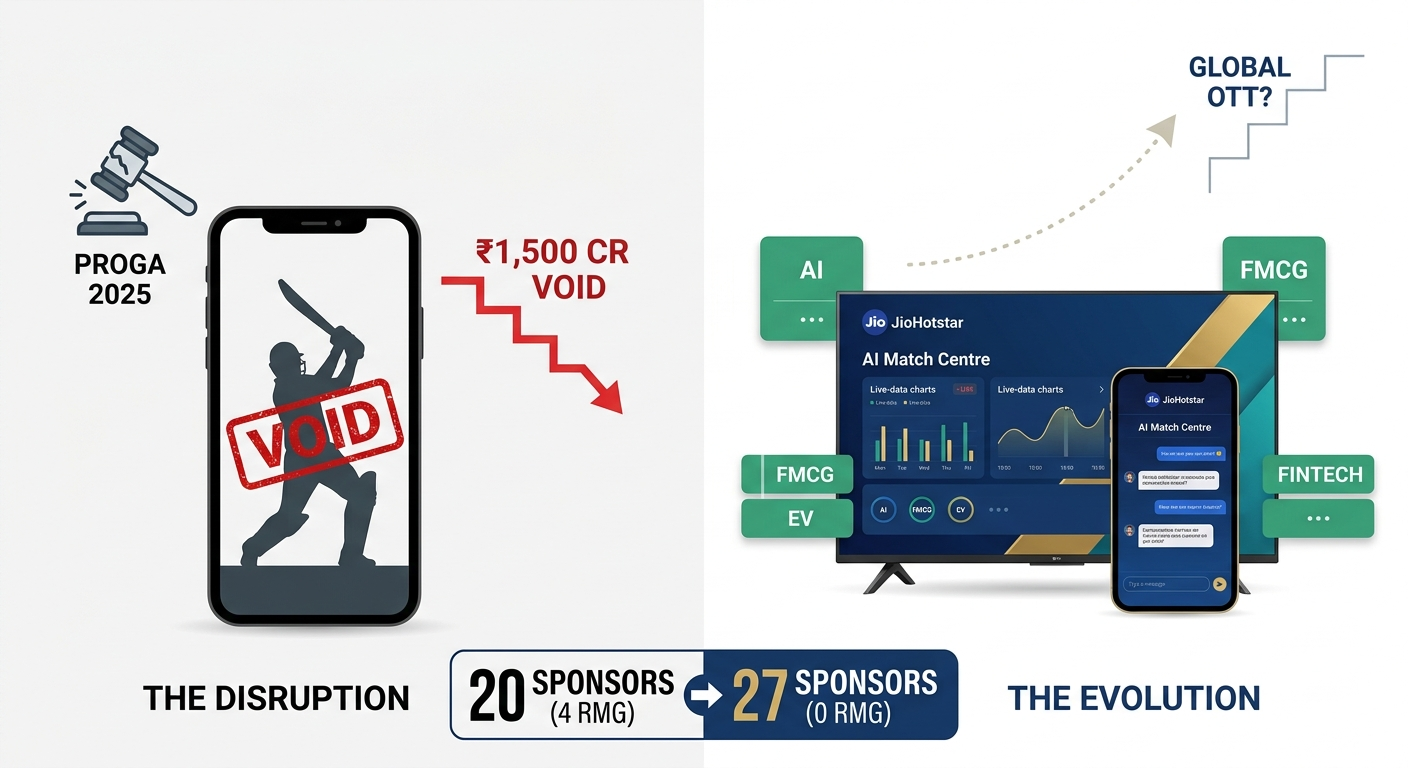
RMG Ban, JIO Star Merger, ₹1,500 Cr Void — Why IPL 2026 Left Fantasy Gaming Behind
When the RMG ban collided with the JIO Star merger, IPL 2026 faced a ₹1,500 crore sponsorship gap — and the brands that filled it revealed a structural shift years in the making. Here’s how.
For the first time in IPL history, valuations fell in back-to-back years — from ₹92,500 crore in 2023 to ₹82,700 crore in 2024, and further down to ₹76,100 crore in 2025. Two events drove this decline: the RMG ban and the Viacom-18–Star India merger. Occurring in consecutive seasons, these two events forced the BCCI to fundamentally rethink how it packaged sponsorships — and how brands showed up inside the tournament.
The Impact of the Viacom-18–Star India Merger on Media Rights
Viacom-18 (JioCinema) and Star India Private Limited (Hotstar) announced a merger on November 14, 2024, which redefined the factors that will determine the valuation of IPL’s media rights — the largest driver of its overall valuation.
For years, these giants competed head-to-head, bidding heavily for acquiring the media rights for IPL and pushing its valuation to extraordinary heights . The cost per match grew from roughly ₹15 crore in the 2008 cycle to ₹118 crore in the 2023–2027 cycle, making IPL the second most valuable media rights property in the world, trailing only the NFL. The total rights value for five years jumped from ₹16,347 crore (2018–22) to ₹48,390 crore (2022–27) — nearly triple in a single cycle.

With very few broadcasters able to match the spending power of Viacom-18 and Star India in the country, the BCCI has shifted toward a long-term, sustainable model — prioritising stable partnerships and consistent value delivery over aggressive bidding wars. This is less a decline and more a correction. With the same broadcasters likely to dominate for the foreseeable future, the BCCI has been pushed to find new areas to monetise — a shift that, in the long run, could actually favour the league.
The bidding wars could resume only when global giants like Netflix, Prime Video, or Fox TV decide to step in — and with IPL’s unmatched reach and worldwide following, there is a high probability that they eventually will.
Promotion Regulation of Online Gaming Act and the 1,500 Crore Void
August 22, 2025, the Parliament of India passed The Promotion Regulation of Online Gaming Act and with that ₹1,500 crore were erased from the ecosystem of IPL’s overall ecosystem. The act prohibits the offering, operation, facilitation, advertisement, and participation in Online Money Games (OMGs), regardless of whether they are games of skill or chance.
The impact fell at two levels. At the league level, PROGA forced the BCCI to sever all ties with RMG apps which resulted in end of Dream11’s shirt sponsorship deals across five franchises— worth ₹358 crore, leaving those clubs scrambling to find replacements and My11Circle’s associate partnership worth ₹625 crores for a period of five years. At the broadcasting level where RMG apps consisted 40% of ad-spends on peak days.
This category of advertisers spent heavily on high-end ad spots often buying them at premium rates. Those spots still have buyers but the real problem lies in the low-end ad spots where RMG brands were prominent buyers.
Wondering what a franchise shirt deal actually involves? We mapped every IPL jersey sponsorship — who pays what, and where the logos go.
The losses due to this regulation are as follows:
| Component | Amount | Notes |
|---|---|---|
| Tier 1 — direct sponsorship deals | ||
| Dream11 — India jersey sponsor | ₹358 cr | 3-year deal through 2026, terminated post-PROGA |
| My11Circle — fantasy category rights | ~₹625 cr | Multi-year association with IPL, void post-ban |
| Dream11 — 5 franchise shirt deals | ₹90–125 cr/yr | GT, KKR, LSG, PBKS, SRH at ₹18–25 cr per team |
| Tier 2 — broadcast advertising spend | ||
| Dream11 — broadcast & OTT ads | ₹300–487 cr/yr | TV, digital, JioCinema integrations per season |
| Baazi Games — Hotstar ads | ~₹90 cr | Single season spend despite not being a heavy spender historically |
| Total | ||
| All RMG platforms combined | ₹1,500–2,000 cr | Total annual IPL-linked ad + sponsorship spend across all RMG brands |
New to IPL’s sponsorship tiers? Our full breakdown explains how every level — from title rights to associate deals — actually works.
The ban ended the aggressive spending by a single category dominating jersey inventory, forcing franchises to diversify, improving their social media presence, rethinking sponsorship strategy, and investing in creative activation.
From Disruption to Diversification — The IPL’s Commercial Reset
After these two seismic events, the BCCI had little choice but to push through structural changes that will permanently reshape IPL’s sponsorship and advertising landscape. Despite the disruption, these changes carry a real upside for the league.
The Viacom-18–Star India merger shifted the balance of power between BCCI and broadcasters. With competition reduced to a single dominant player, broadcasters now negotiate from a position of strength, limiting the escalation of media rights values. In response, the BCCI has moved toward a co-growth model, one where both parties extract maximum value from the deal rather than just inflating the rates through aggressive bidding. On the advertising side, however, the RMG ban created the opposite dynamic.
After the merger path for brands has been simplified. Brands now have access to:
- One-Stop Buying: Brands can secure a unified deal across TV and digital platforms, reducing administrative complexity.
- Unified Targeting: Merged platforms offer unified customer data, enabling cross-device targeting and consistent messaging.
- Access to Premium Inventory: JioHotstar now has the exclusive rights to broadcast premium events like IPL,ICC events, and the English Premier League and brands don’t have to break their budget between competing platforms for targeting a complex customer base.
- Enhanced Ad Formats: The integration allows for innovative ad placements, such as branded overlays on live stats and sponsor logos on multi-camera screens, which were previously difficult to coordinate across separate TV and digital teams.
Before the act was passed, Dream11 held a front-of-jersey sponsorship with the BCCI for the Indian national team worth ₹358 crore, along with shirt sponsorship deals across five IPL franchises. Meanwhile, My11Circle had secured a five-year Associate Sponsorship deal with the BCCI for the Indian Premier League worth ₹625 crore. With both deals rendered void overnight, the BCCI was forced to rethink its sponsorship strategy from the ground up. BCCI firstly replaced Dream11 with the automobile giants Apollo Tyres with deal worth ₹579 crore for a period of two and a half years and then My11Circle with Gemini worth ₹270 crore for 3 years.

Difference between brands advertising on JioHotstar pre RMG ban and Post RMG ban:
| Sponsorship Tier | IPL 2025 (Pre-Ban) | IPL 2026 (Post-Ban) | Shift |
|---|---|---|---|
| Co-Presenting | My11Circle, Campa Energy, Thums Up | Google Search AI Mode, Campa Energy, Havells & Lloyd | RMG out → AI in |
| Co-Powered | Birla Opus, PokerBaazi, Zupee | Birla Opus, Hero MotoCorp, Amazon.in | RMG out → traditional + e-commerce in |
| Associate Sponsors | SBI, PhonePe, GPay, Allen Solly, TVS, Asian Paints, Joy Cosmetics, Amul, Dream11, Jaquar, Kent | AMFI, Asian Paints, Vimal Elaichi, MRF, Flipkart Minutes, Gillette, RuPay, Mondelez, Mother Dairy, Groww, Rapido, Muthoot Finance, Sunfeast YiPPee!, Google Pay, TVS EV, Angel One, Campa Sure, Amul | Expanded — 8 to 18 brands |
| Show Presenter | Amul (Cricket Live) | Amul (Cricket Live), Google Search AI Mode (Match Centre Live) | Expanded |
| Total Sponsors | 20 brands — 4 RMG brands present | 27 brands — 0 RMG brands | +7 brands, 0 RMG |
IPL 2025 — Pre-Ban—20 sponsors—RMG brands present across all broadcast tiers
IPL 2026 — Post-Ban—27 sponsors—No RMG brands — diversified across AI, FMCG, EV, fintech
Nowadays, brands have increasing emphasis on packaging and activation of their sponsorship deals, extracting maximum value from their spendings, tech giant like Google Search AI Mode and Gemini in IPL has used the platform to a different level of extent, utilizing it not just for brand exposure but to convert the casual or first time users to daily power users by transitioning them from passive viewers to active problem solvers within the conversational chat interface.
They are not just here for brand exposure but instead for brand utility.
Another case worth highlighting is that of FMCG and quick-commerce brands like Swiggy, Zomato, Blinkit, and JioMart, who are capitalising on high-intensity moments such as when a wicket falls, a batsman completes a century, or a fielder takes a stunning catch, thriving on the pulse of the audience and driving action through personalised, AI-generated discounts that boost direct sales and conversions.
The mechanics of sponsorship and advertisement are evolving faster than ever and BCCI has been able to catch up till now and it is far better than just thriving on aggressive bidding wars.
This isn’t the first time BCCI rebuilt its commercial engine from scratch. Here’s what the Vivo exit in 2020 taught them — and how it shaped the playbook they’re using now.
The Future of IPL’s Sponsorship and Broadcasting Landscape
JioStar’s season metrics show 235 million connected-TV viewers, 417 million mobile viewers and double-digit growth in regional feeds (Telugu +87%, Kannada +65%, Tamil +52%), demonstrating that the IPL’s national footprint has become more localised and deeper at the same time.

IPL is one of the most viewed events across the globe, recording over a billion views in the 2025 edition across platforms which is its biggest strength. With digital viewership leading the battle for the first time over TV-viewership, JioHotstar reported growth from roughly 50 million subscribers in February to 270 million by May 2025.
The numbers point to one clear conclusion: the IPL has barely scratched the surface of its monetisation potential. International broadcasting is virtually non-existent today, meaning the biggest revenue lever has not been pulled yet. When global players finally step in, the current figures will be dwarfed, and given the league’s reach and growth, the question is not if but when.
The IPL’s commercial story in 2025–26 is not one of decline — it is one of forced maturity. The JioHotstar merger ended the bidding wars that inflated media rights values artificially, and PROGA wiped out a category of advertiser that had become a structural dependency. Both disruptions stung. But what replaced them — Google’s AI activations, Apollo’s pan-franchise presence, Gemini’s three-year commitment, a 27-brand sponsor roster with zero RMG dependency — is a more durable foundation than what existed before. The league that once leaned on fantasy gaming to fill inventory is now attracting the world’s largest technology companies as utility partners, not just logo buyers. International broadcasting rights remain the last untapped frontier. When global streamers finally bid, they will inherit an ecosystem that has already done the hard work of growing up.